

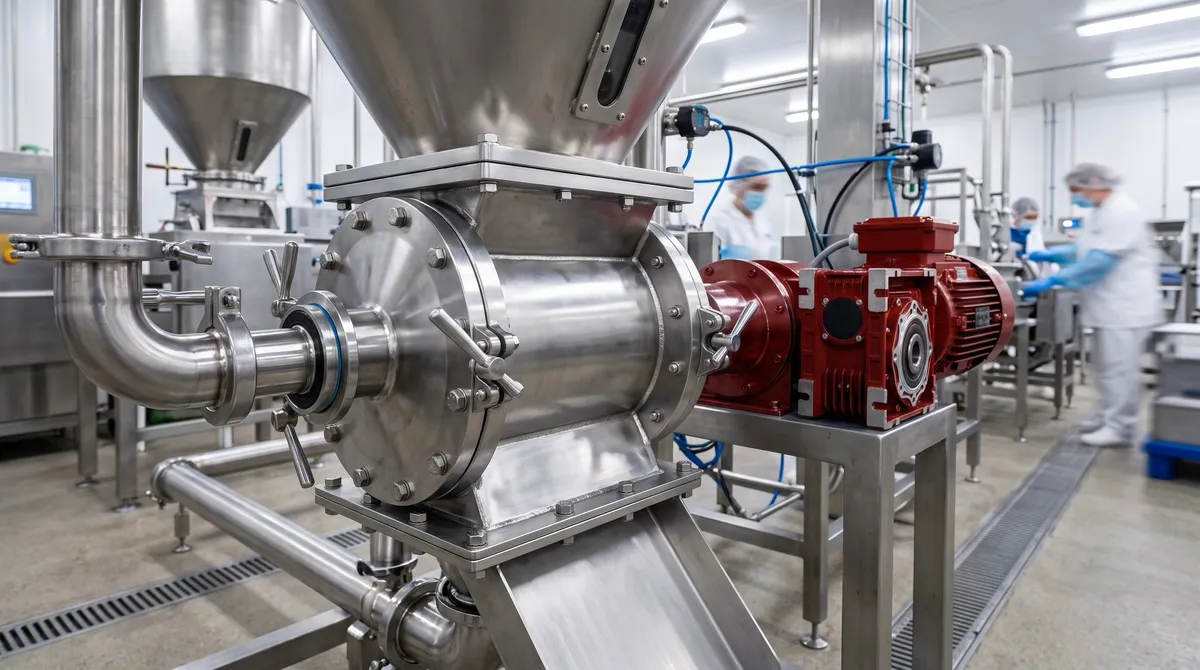
Choosing the right Rotary Valve for the Food Industry can make or break your production line. A poor choice leads to contamination risks, product waste, and costly downtime. Many buyers focus only on price, ignoring critical features like hygienic design and material compatibility.
In this guide, you'll discover essential features that ensure food safety, maximize efficiency, and protect your investment. Let's explore what makes a rotary valve truly food-grade.
What Is a Rotary Valve?
A rotary valve is a mechanical device that controls the flow of bulk materials between different process stages. Think of it as a revolving door for powders and granules.
The valve consists of:
A rotating rotor with vanes or pockets
A sealed housing
Inlet and outlet ports
Drive mechanism
For Food Processing Equipment, these valves must meet strict hygiene and safety standards beyond regular industrial versions.
Why Food Industry Needs Specialized Rotary Valves
Food Safety Requirements
Standard industrial valves won't cut it in food processing. Here's why:
Regular Industrial Valve | Food Grade Rotary Valve |
Cast iron construction | Stainless Steel Rotary Valve |
Basic seals | FDA-approved seals |
Painted surfaces | Polished, crevice-free design |
Standard tolerances | Precision-machined components |
Critical Functions in Food Processing
Sanitary Rotary Valves serve multiple purposes:
Maintain product purity
Prevent cross-contamination
Control material flow rates
Create airlock barriers
Minimize product damage
Top Features to Look for in a Rotary Valve for Food Industry
Food-Grade Construction Materials
Hygienic Rotary Valves must use:
304 or 316 stainless steel
FDA-compliant elastomers
Food-safe bearing lubricants
Non-toxic surface treatments
Hygienic Design Elements
Look for these sanitary features:
Smooth, polished surfaces
Rounded corners (no dead zones)
Self-draining design
Minimal crevices
Easy disassembly
CIP (Clean-In-Place) Compatibility
Modern Food Processing Plant Equipment needs CIP capability:
Spray ball connections
Proper drainage angles
Chemical-resistant materials
Temperature tolerance up to 95°C
Effective Sealing Systems
Dust Control Valves require:
Air purge seals
Adjustable rotor clearances
Wear-resistant materials
Contamination barriers
Key Performance Features
Material Handling Capabilities
Feature | Why It Matters |
Low shear design | Preserves particle integrity |
Adjustable speed | Controls feed rate precisely |
Large inlet opening | Prevents bridging |
Wear plates | Extends service life |
Rotary Valve Capacity Considerations
Flow rates: 0.1 to 500 m³/hr
Pressure differentials: up to 1.5 bar
Temperature range: -20°C to 200°C
Bulk density compatibility
Common Buying Mistakes to Avoid
Choosing wrong materials - Carbon steel in corrosive environments
Undersizing - Leads to blockages and wear
Ignoring maintenance access - Increases downtime
Skipping customization - One-size-fits-all rarely works
Price over quality - Cheap valves cost more long-term
Industry-Specific Applications
Flour Handling Rotary Valve Requirements
Explosion-proof design
Anti-static features
Fine particle sealing
High throughput capacity
Sugar Handling Valve Specifications
Corrosion-resistant coating
Temperature management
Crystallization prevention
Sticky material handling
Application Table
Industry | Material Type | Key Requirements |
Flour Mills | Fine powders | ATEX certification, dust-tight |
Spice Processing Equipment | Aromatic powders | Flavor retention, easy cleaning |
Dairy Processing Equipment | Milk powder | Ultra-hygienic, CIP-enabled |
Coffee | Beans/grounds | Low damage, aroma preservation |
Snacks | Granules | Gentle handling, size preservation |
Oswar Rotocorp supplies specialized Rotary Valves for these applications, with designs tailored to each industry's unique challenges.
Rotary Valve Selection Guide
Quick Selection Checklist
✓ Material compatibility - Will it corrode or contaminate?
✓ Capacity match - Can it handle your throughput?
✓ Pressure rating - Suitable for your system?
✓ Cleaning method - Manual or CIP?
✓ Certification needs - FDA, 3-A, EHEDG?
✓ Installation space - Fits your layout?
✓ Maintenance access - Easy to service?
Why Food Manufacturers Choose Oswar Rotocorp Rotary Valves
Engineering Excellence
Oswar Rotocorp manufactures Industrial Rotary Valves using precision CNC machining, ensuring tight tolerances and consistent performance. Their Stainless Steel Rotary Valves feature mirror-polished finishes and crevice-free designs.
Customization Capabilities
Unlike one-size-fits-all solutions, Oswar Rotocorp offers customized Rotary Valve for Powder Handling based on:
Material characteristics
Required throughput
Installation constraints
Process conditions
Proven Reliability
With installations in flour mills, sugar plants, and spice processing facilities worldwide, their Rotary Feeder for Food Industry solutions deliver consistent performance and minimal downtime.
Rotary Valve Maintenance Best Practices
Daily Checks
Visual inspection for leaks
Listen for unusual sounds
Monitor motor temperature
Check seal integrity
Weekly Tasks
Lubricate bearings (if required)
Inspect rotor clearance
Clean exterior surfaces
Verify flow rates
Monthly Procedures
Deep cleaning cycle
Seal replacement (if worn)
Alignment verification
Performance testing
Buyer's Pre-Purchase Checklist
Technical Requirements
□ Material type and properties
□ Required flow rate
□ Operating pressure
□ Temperature range
□ Installation orientation
Compliance Needs
□ FDA materials certification
□ 3-A dairy standards
□ ATEX requirements
□ Local food safety regulations
Operational Factors
□ Cleaning frequency
□ Maintenance schedule
□ Operator skill level
□ Integration requirements
Making Your Rotary Valve for Food Industry Investment Count
Selecting the right Pharmaceutical Grade Rotary Valve requires balancing multiple factors. Focus on long-term value over initial cost. Quality equipment from reputable Rotary Valve Manufacturers like Oswar Rotocorp pays for itself through reduced downtime, better product quality, and compliance confidence.
Ready to upgrade your Bulk Material Handling Equipment? Contact us for expert guidance in selecting the perfect Rotary Valve for Food Processing Plant applications. Our team can help you specify the ideal solution for your unique requirements.
Frequently Asked Questions
1. What materials are best for a Food Grade Rotary Valve?
Stainless Steel Rotary Valves using 304 or 316 grade steel offer the best combination of hygiene, durability, and corrosion resistance. FDA-approved seals and food-grade lubricants are equally important for complete food safety compliance.
2. How often should I clean a Sanitary Rotary Valve?
Cleaning frequency depends on your product and regulations. Dry products may need weekly cleaning, while dairy applications require daily CIP cycles. Hygienic Rotary Valves with CIP capability simplify this process significantly.
3. What's the typical lifespan of a Rotary Valve for Food Industry?
Quality Food Processing Equipment like those from Oswar Rotocorp typically last 10-15 years with proper maintenance. Rotor replacement every 3-5 years extends overall valve life considerably.
4. Can one rotary valve handle multiple food products?
Yes, with proper cleaning between products. Sanitary Rotary Valves with quick-release designs and CIP systems enable efficient product changeovers while preventing cross-contamination.
5. How do I size a Rotary Valve for Dry Powder Handling?
Consider bulk density, particle size, flow rate requirements, and filling percentage (typically 75-80%). Rotary Valve Capacity calculations should include safety margins for consistent operation.
6. What certifications should I look for when buying food-grade valves?
Look for FDA material compliance, 3-A certification for dairy, EHEDG design approval, and CE marking. Reputable Rotary Valve Suppliers provide complete documentation.
7. How do I prevent product damage in fragile materials?
Choose Rotary Feeders for Food Industry with low-speed options, rounded rotor tips, and minimal clearances. Adjustable speed drives allow fine-tuning for product protection.
8. What's the difference between rotary valves and rotary airlocks?
All Airlock Rotary Valves are rotary valves, but not all rotary valves provide airlock function. Airlocks specifically maintain pressure differentials while feeding material.
9. Can rotary valves handle sticky or cohesive food products?
Yes, with special features like heated housings, anti-stick coatings, and flexible rotor tips. Sugar Handling Valves often include these modifications for reliable operation.
10. How much does a quality Food Grade Rotary Valve cost?
Prices typically range from ₹4 lakh to ₹40 lakh+, depending on the size, material, design, and customization requirements. Stainless Steel Rotary Valves have a higher initial cost but provide better long term value through greater durability, improved hygiene, and reduced contamination risk.
